Advancing Interoperability of Space-based EO Data and Services: The CEOS Interoperability Handbook
Interoperability refers to the ability of data, systems, and services that are often developed independently to work together seamlessly. For Earth observation (EO) data providers and distributors, this means enabling users to discover, access, integrate, and analyse data from multiple sources without unnecessary technical, semantic, or policy barriers. 
Interoperability of data and services in the space-based EO domain is essential due to fundamental limitations of the data, including revisit times, potential launch or on-orbit failures that can result in data gaps, and spatial resolution constraints, as well as increasing cooperation between public and commercial space actors worldwide.
Recognising the importance of EO interoperability, CEOS developed and published the CEOS Interoperability Handbook 1.1 in 2008. Fifteen years later, the rapid increase in the number of EO satellites and associated complex sensors providing ever-growing volumes of data, combined with more complex user requirements, motivated CEOS to develop the CEOS Interoperability Framework, which was endorsed at the 2023 CEOS Plenary. Building on this framework, CEOS subsequently reviewed the interoperability of data services in the current context and developed the CEOS Interoperability Handbook 2.0, which was endorsed by CEOS Plenary in 2025. The development was led by the CEOS Working Group on Information Systems and Services (WGISS), with contributions from various CEOS entities, including theWorking Group on Calibration and Validation (WGCV), CEOS Systems Engineering Office (SEO), the CEOS Analysis Ready Data Oversight Group, and the Land Surface Imaging Virtual Constellation (LSI-VC). The Handbook underwent broad community consultation throughout 2025, including in-depth review and discussion at WGISS, WGCV and Strategic Implementation Team (SIT) meetings. In line with CEOS recommendations, it is maintained openly on GitHub, enabling transparency, version control, and ongoing feedback from the wider EO community.
The handbook guides EO data providers, system architects, and policy stakeholders, across both the public and private sectors, in building interoperable data and service infrastructures. It emphasises modularity, openness, and machine-actionability, aligning with global initiatives under the Group on Earth Observations (GEO) including GEO Data Licensing Guidance and QA4EO, FAIR data principles, and open science mandates.
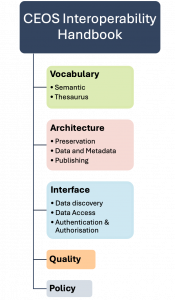
Factors of Interoperability
The Handbook provides a total of 76 recommendations across five complementary factors, each addressing a distinct but interrelated dimension:
- Vocabulary (Semantics) details how terms and expressions should be named and defined to ensure concepts are understood consistently across organisations.
- 14 recommendations, across Semantic and Thesaurus sub-sections
- Led by LSI-VC
- Architecture describes the organisational structure of concepts, processes, and data assets, including models and standards governing data collection, storage, archiving, documentation, and publication.
- 25 recommendations, across Preservation, Data & Metadata, and Publishing sub-sections
- Led by SEO and WGISS
- Interface (Accessibility) addresses how users and systems discover and access data and services, including data exchange protocols and application interfaces.
- 16 recommendations, across Data Discovery, Data Access, and Authentication & Authorisation sub-sections
- Led by WGISS
- Quality focuses on the indicators for informing users about the trustworthiness of the data, including accuracy, uncertainty, and consistency.
- 9 recommendations
- Led by WGCV
- Policy considers the legal, organisational, and governance context, including data licensing, access conditions, procurement, and alignment with open data and open science principles.
- 12 recommendations
- Led by WGISS and SEO
The Handbook recognises that modern EO systems must support distributed, cloud-native, and user-driven architectures. The emphasis is on enabling seamless integration across agencies, platforms, and applications, rather than simply connecting catalogues or services.
To support practical adoption of the Handbook, CEOS, led by WGISS, is developing two follow-on activities. The first is an Interoperability Maturity Matrix, which will allow data and service providers to assess their current level of interoperability across the five factors, track progress over time, and identify priority areas for improvement. The matrix will be aligned with existing CEOS Maturity Matrix frameworks developed by WGCV and WGISS.
The second activity is a set of Interoperability Demonstrators, which will be developed using the Interoperability Handbook and will help end users better understand the barriers to implementing interoperability.
CEOS encourages data providers, distributors, and service operators to review the CEOS Interoperability Handbook 2.0, consider its recommendations in their own operational contexts, and provide feedback through the GitHub repository.