Climate Data Record (CDR) Inventory: Evolution of the ECV Inventory
Climate Monitoring Architecture for Space-based Observations
Satellite data play a pivotal role in observing variability and change in the Earth system. Their view from above allows for consistent, global coverage, observing many Earth System variables across the atmospheric, oceanic and terrestrial domains.. With some satellite observations now spanning more than 50 years, satellite data has become an invaluable tool for monitoring variability and long-term changes in Earth’s climate.
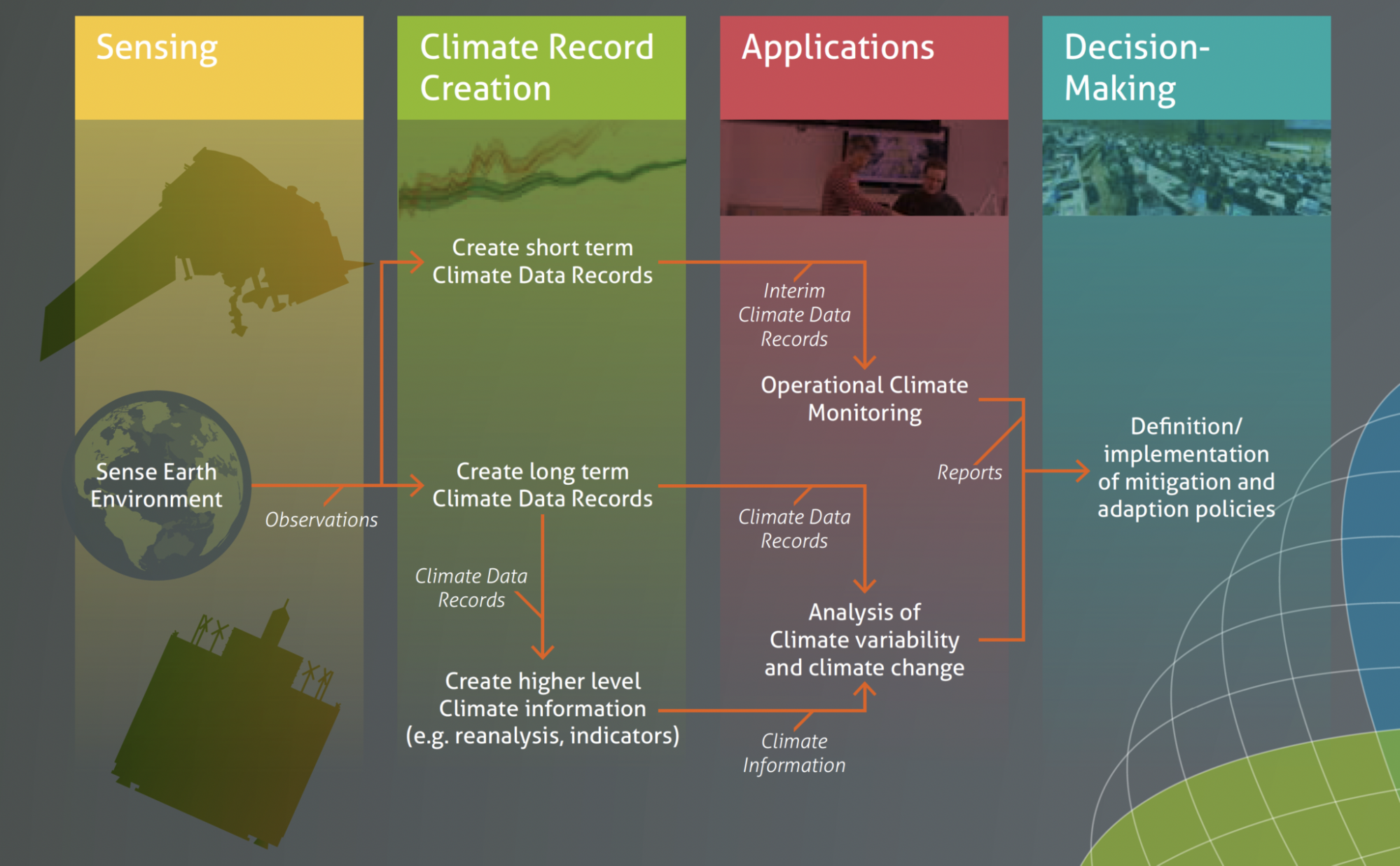
Following requirements established by the Global Climate Observing System the CEOS/CGMS Joint Working Group on Climate (WGClimate) developed the Climate Monitoring Architecture for Space-based Observations. This strategy, published in 2013, led to WGClimate creating the Essential Climate Variables (ECV) Inventory. The first verified version of the ECV Inventory was published in 2017.
Supported by EUMETSAT and the European Commission, the ECV Inventory was generated from inputs of individual agencies, and included information on existing and planned CDRs, including frequently updated interim CDRs. A unique feature of the inventory is the information of the real use of the space segment for the production of CDRs by agencies, which allows detailed estimations of needs for measurement continuity and improvement. WGClimate regularly performs such analysis, and publishes the results in the form of Gap Analyses and Coordinated Action Plans, the most recent being published in 2024. The Inventory went through six versions, with each new version containing the latest information from CEOS and CGMS Agencies.
 The CDR Inventory is built off ECV Inventory v6.0, and now includes:
- An improved user interface to enhance discoverability and uptake
- Added functionalities to improve navigation
- Streamlined information for easier filtering and analysis of data
- Documented API for information retrieval.
The process to update the Inventory has also been reimagined. The CDR Inventory is now continuously updated, with a simplified process to populate the database and verify the contents, which is important to provide reliable and up to date information.
WGClimate is also progressing an activity to create a user typology for the CDR Inventory – mapping application areas to Earth System variables. This will allow users to easily explore which datasets may be suitable for their specific needs, increasing the reach and usability of the Inventory. The new typology is expected to be implemented online later in 2026.
Future work for the CDR Inventory includes:
- Adding non-GCOS climate-relevant variables
- Creating a companion Fundamental CDR (FCDR) Inventory
- Development of a set of tools supporting users
- Enabling interfacing with AI agents for information retrieval and analysis
After a few rounds of update and publication, it was found that the ECV Inventory format and update process could be improved to enhance its usage beyond the space agencies by making it an information base on CDRs for everybody. In 2024, the CEOS-CGMS WGClimate renamed the tool to the CDR Inventory and the EUMETSAT team managing the inventory started developing a new technical baseline for it.