New CEOS-ARD Specifications for Surface Temperature Satellite Data
As thermal data of the Earth’s surface become increasingly important for monitoring the planet’s climate, agriculture, infrastructure, and natural disasters (wildfires, droughts) and as more data providers emerge, product specifications that provide a shared reference and understanding of how to process and package products are key to building user confidence and uptake.
CEOS Analysis Ready Data (CEOS-ARD) provides a clear framework for ensuring data meets a minimum level of processing into a form that users need. The CEOS-ARD Product Family Specifications (PFS) define mandatory requirements for a product’s processing, metadata, and documentation. CEOS-ARD certified data allows immediate analysis with minimal additional user effort and interoperability through time and with other datasets.
Read the latest CEOS Analysis Ready Data (CEOS-ARD) specifications for Surface Temperature here:
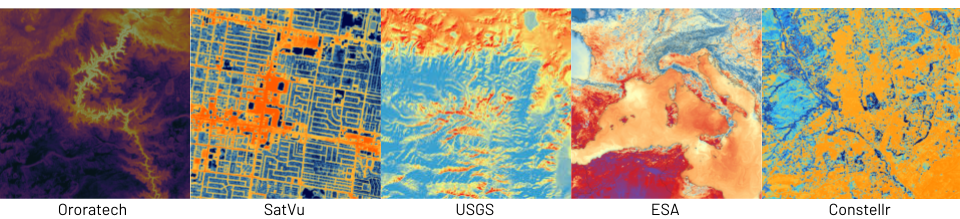
The PFS for Surface Temperature (ST) was first developed in 2017 by a group of CEOS Agencies representing the majority of thermal infrared satellite missions flying at the time. In recent years, the landscape of these missions has begun to shift with the emergence of dedicated commercial thermal imaging companies and new satellite missions. Bringing new technologies, applications, and perspectives to the community, these providers highlighted the need to consider how the existing PFS could evolve to meet the growing diversity of thermal data sources. The CEOS Land Surface Imaging Virtual Constellation (LSI-VC) invited commercial providers, including SatVu, Ororatech, Constellr, and Aistech, to its CEOS LSI-VC-18 Meeting in 2025 to discuss the existing Surface Temperature PFS.
Preliminary self-assessments from commercial providers against the ST PFS v5.0 highlighted both areas of alignment and areas where the existing requirements were difficult to meet. The PFS had limited applicability for surface brightness temperature (SBT) and non-reflectance products in general, as well as other requirements that were difficult for high-resolution and commercial missions to satisfy. These findings provided a valuable starting point for LSI-VC and the commercial sector to explore, together, where the PFS could be updated.
Taking place between 2025 and 2026, a public-private sector effort saw a major overhaul of the Surface Temperature PFS. New requirements were introduced for emissivity and anisotropy, and terrain occlusion, with increased rigour for requirements on processing chain provenance and uncertainty. The PFS was also brought into line with recent evolutions of other CEOS-ARD Specifications, ensuring alignment.
To ensure compatibility with surface brightness temperature products, the PFS was split into two: the updated version of the existing PFS, Surface Temperature v6.0.0, and its twin, Surface Brightness Temperature v1.0.0. Both PFS are consistent with one another, except that SBT does not feature a requirement for per-pixel information on Emissivity and Anisotropy.
CEOS-ARD Product Family Specifications for Surface Temperature (left) and Surface Brightness Temperature (right)
The update process for the PFS followed a new workflow that revolves around a set of modular metadata requirement ‘building blocks’ created and maintained in the CEOS-ARD GitHub repository. Working in this environment enabled open collaboration with the CEOS-ARD community, robust version control, and full transparency. It has also paved the way for the creation of new PFS built as extensions of existing ones, by adapting their building block ‘recipes’ to introduce new requirements. The implementation of this workflow across CEOS-ARD has shed light on inconsistencies between the different PFS and presented opportunities for harmonisation. The team thanks the CEOS Systems Engineering Office (SEO) for providing technical support to steer the PFS’ updates through the building block workflow.
The two updated PFS apply to:
“Data collected with satellite sensors operating in the thermal infrared (TIR and MWIR) and microwave wavelengths. These typically operate with ground sample distance and resolution in the order 1 dm – 50 km; however, the specification is not inherently limited to these resolutions.”
Expanding from land surface temperature (LST) only, Version 6.0.0 also broadly caters to surface temperature measurements of water and ice, thanks to inputs from the Group for High Resolution Sea Surface Temperature (GHRSST) and the CEOS SST Virtual Constellation. A future evolution of the PFS may introduce dedicated ice or SST requirements, in alignment with the GHRSST Data Specifications (GDS).
With ST v6.0.0 and SBT v1.0.0 endorsed at the LSI-VC-20 Meeting in September 2026, the CEOS-ARD team now welcomes and encourages assessment against the PFS. These PFS will also set a foundation for discussions in the LSI-VC Wildfire Subgroup around higher-level, derived PFS for applications such as active wildfires.
Find the PFS linked below along with some additional helpful information: