Ensuring Quality and Fit-for-purpose Data with the CEOS-FRM Assessment Framework
Post-launch calibration and validation (Cal/Val) is essential to ensure that satellite observations remain accurate, comparable and fit for purpose throughout their operational lifetime. The concept of a Fiducial Reference Measurement (FRM) was established by the EO community as a practical means to identify independent reference data that demonstrably meets quality assurance principles. The CEOS-FRM initiative, led by the CEOS Working Group on Calibration and Validation (WGCV), provides an assessment framework and tool to evaluate the suitability of reference measurements.
The Quality Assurance Framework for Earth Observation (QA4EO) defines CEOS-FRM as:
Satellite Cal/Val has traditionally relied on a wide range of datasets, including in-situ and aircraft campaigns, opportunistic inter-sensor comparisons, and modelled natural phenomena. While these approaches provide valuable information, it can be difficult to determine which datasets are of sufficient quality and optimised for satellite applications. ESA introduced the concept and label of FRMs to define a distinct class of observations specifically designed to meet the needs of satellite Cal/Val.
CEOS WGCV recognised the need for a formal framework to assess and endorse such measurements, leading to the development of the CEOS-FRM Assessment Framework. CEOS-FRM compliant data enable satellite operators to clearly understand the quality, traceability, and fitness for purpose of Cal/Val data for specific satellite products.
A number of in-situ reference networks and sensors have undergone preliminary evaluations against the CEOS-FRM Assessment Framework. These include:
- PGN (Pandonia Global Network)
- RadCalNet (Radiometric Calibration Network)
- ICOS (Integrated Carbon Observation System – Ecosystem Component)
- FRM4DOAS (Ground-Based DOAS Air-Quality Observations)
- BAQUNIN (Boundary-layer Air Quality-analysis Using Network of Instruments Super Site)
- CSIRO (DION)
- Brewer Spectrometer – NO2 Vertical Column Densities (VCDs) Measurements
- FRM4GHG 2.0 project – COCCON
- CREGARS (Centre for Reactive Trace Gases Remote Sensing)
The mandatory defining characteristics for CEOS-FRM are:
- Traceability: FRM measurements are traceable to a community-agreed reference (ideally SI units) through metrology standards or best practices.
- Independence of satellite-under-test: FRM measurements are independent from the satellite geophysical retrieval process.
- Uncertainty budget: A comprehensive uncertainty budget for all FRM instruments and derived measurements is available and maintained.
- Documented protocols: FRM measurement protocols, procedures and community-wide quality management practices are defined, published and adhered to.
- Accessibility: FRM datasets, metadata, and processing information are openly available to allow independent verification of other processing systems.
- Representativeness: FRM measurements are demonstrably comparable to what the satellite observes, with documented comparison methods and uncertainties.
- Adequacy of Uncertainty: The uncertainty of the FRM and its comparison process meet the validation requirements of the satellite.
- Utility: FRM datasets are designed to apply to a class of satellite missions and are not mission-specific.
In order to self-assess and verify a CEOS-FRM, a maturity matrix approach is used. Submissions are graded against specific criteria, and assigned colours indicating their level of compliance. Data providers pursuing CEOS-FRM compliance would self-assess their datasets against the matrix after collating the required documentation and evidence.
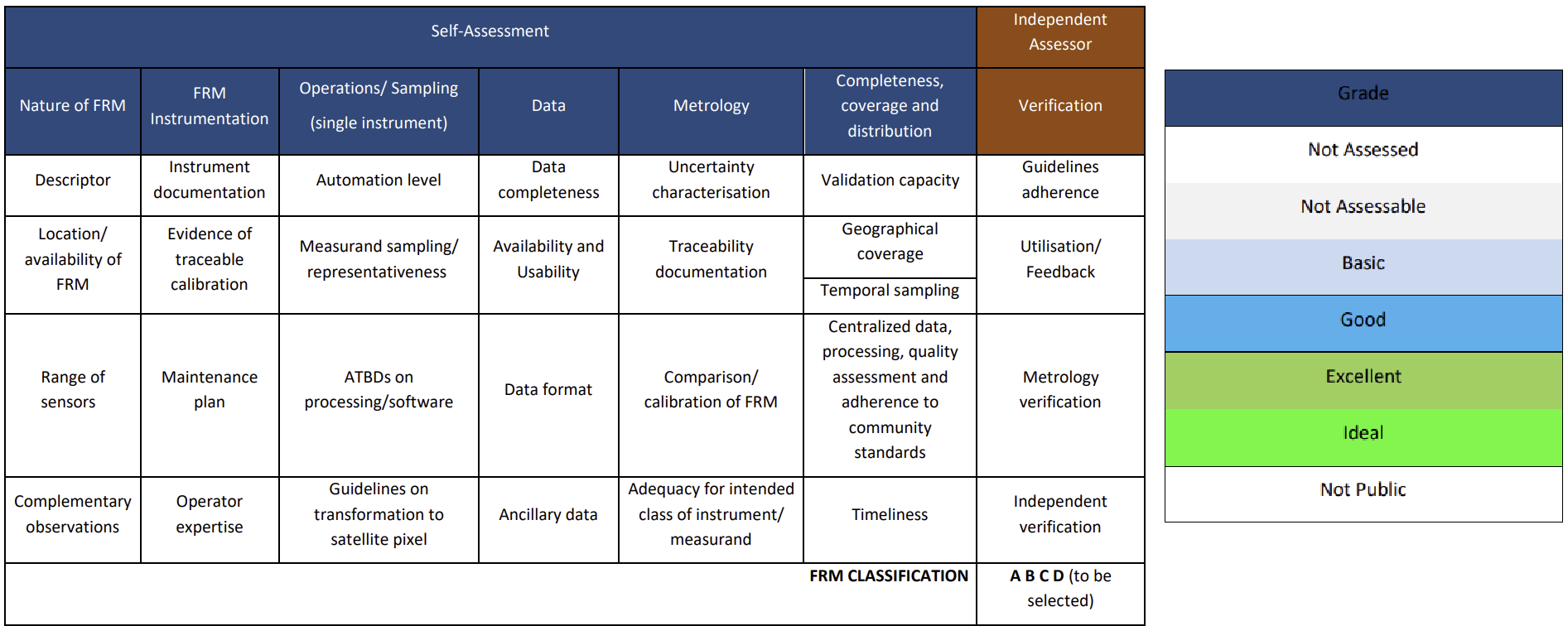
The matrix is a visual representation that provides a quick overview to assess the state of any FRM against each set of given criteria, making visible, for potential users, where it is mature and where evolution and effort are still needed. It contains categories to assess the FRM’s basic suitability for the intended measurand, the instrumentation, level of automation and processing, metadata format and availability, metrological quality, and the overall completeness, coverage and distribution of measurements.
WGCV is currently undertaking a series of pilot exercises to test the CEOS-FRM maturity matrix assessment, inviting providers of calibration and reference measurement networks to submit and evaluate FRMs against the framework. A second round of exercises is being conducted in 2026 and contributions from FRM providers are welcomed.