Consulting the Community to define the Future of CEOS Analysis Ready Data (CEOS-ARD)
Throughout 2025, the CEOS-ARD Oversight Group undertook a comprehensive consultation effort to gather feedback on what the Earth observation community would value in the next phase of CEOS-ARD. This feedback formed the basis of the Future of CEOS-ARD – Consultation Paper and Concept Note endorsed by CEOS Principals at the 39th CEOS Plenary in November 2025.
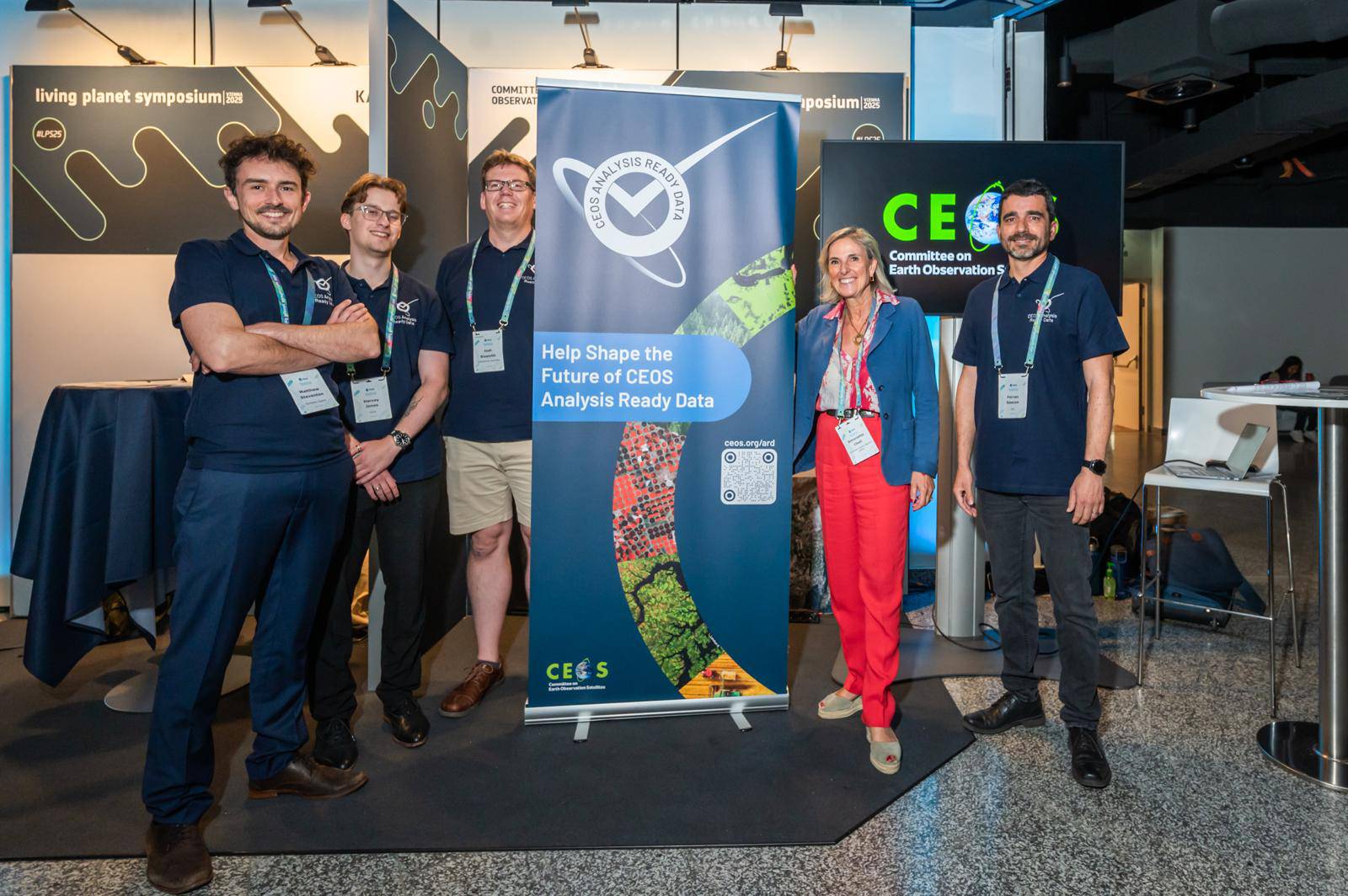
CEOS-ARD team at LPS 2025
The Future of CEOS-ARD survey was opened in June 2025, and sought community feedback on matters that could be considered by an ambitious next-generation future CEOS-ARD Strategy. To date, the survey has collected over 110 responses, and remains open for those who haven’t yet shared their views. The survey was promoted at many events across the year, including European Space Agency’s Living Planet Symposium (LPS), the 2025 International Geoscience and Remote Sensing Symposium (IGARSS) and the 2025 International Astronautical Congress (IAC) – bringing in a wide range of perspectives.
With this feedback in hand, the CEOS-ARD team identified fourteen categories that a future CEOS-ARD strategy should consider:
- Consistent and Enhanced Metadata Specifications – There is an opportunity to increase alignment of CEOS-ARD Product Family Specification metadata, update requirements, and maximise compatibility with STAC and OGC/ISO standards.
- Data and Metadata Quality – While datasets might satisfy all of the reporting requirements of CEOS-ARD, there are no quantitative bounds placed on the ‘quality’ of these characteristics. Clearer expectations will build trust and aid data providers.
- Ongoing Quality Assurance and Integrity Monitoring – Assessments are currently one-off exercises with no ongoing checks. Introducing continuous quality/integrity monitoring and provenance tracking would support ongoing tracking of performance and provide clarity for users.
- Fitness for Purpose – Adding fitness-for-purpose guidance would help classify products, improve transparency, and support both users and providers.
- Increased Support to Scientific Applications and Environmental Adaptation and Resilience – Including additional requirements related to long-term accuracy/stability would facilitate long-term records, and support adaptation and resilience ambitions.
- Solidifying the Business Case and Increasing Commercial Relevance – CEOS-ARD can support procurement as a clear and transparent common baseline and reduce duplication of effort and work on both the customer and data provider sides.
 Tools to Aid Compliance Assessments and Peer Reviews – Manual compliance assessments are not scalable. Automated CEOS-ARD validation tools, web forms, and clearer guidance can streamline reviews, reduce burden, and increase uptake.
- Supporting Opportunities and Reducing Risks Related to AI / ML – CEOS-ARD can be positioned as a “gold-standard” source for Geospatial Foundation Models (GFMs) and other AI/ML applications by requiring strong provenance and traceability information.
- Measurand Consistency and Algorithm/Application Resilience – Improved measurand consistency would strengthen multi-sensor time-series use, operational resilience, and confidence in data supply.
- Alignment with the Software Ecosystem – Uptake of CEOS-ARD will be limited if CEOS-ARD metadata and data are not readily interpreted by widely used software tools.
- Analysis Ready Data Standards – CEOS-ARD can lead by developing a flexible, community-driven framework that matures into a formal standard at the appropriate time. CEOS should continue fostering broad engagement and develop a clear roadmap for ARD standards.
- Thematic and Higher-level CEOS-ARD Products – Expanding to thematic and higher-level products can facilitate expanding user needs.
- Training and Outreach – Expanded outreach, multilingual documentation, and provider/user support to boost user adoption.
- Capturing Use and Impact – Compiling strong examples and compelling case studies will strengthen advocacy, demonstrate value, and encourage increased adoption.
CEOS Principals have now tasked the CEOS-ARD Oversight Group to develop a new 2026 CEOS-ARD Strategy, building on the concept note. This task has also been prioritised by the new CEOS Chair Team, formed of CSIRO, Geoscience Australia, and the Bureau of Meteorology. The 2026 CEOS-ARD Strategy will be delivered at the 40th CEOS Plenary, in November 2026.
Community feedback is still welcome via the survey, and the team thanks everyone that has provided valuable feedback to date.
For more details on the survey responses and the topics described above, please see the concept note.