Space-based Data For Wildfires: WGDisasters Wildfire Pilot
Wildfires are uncontrolled fires which burn in an area of combustible vegetation. In the right conditions, they can quickly become out of control and hence early identification, as well as ongoing monitoring and management, is critical. The challenge to monitor and control wildfires is increased due to their location in rural or remote areas, which can often be difficult to access with traditional monitoring methods. This is where satellites can help.
Due to their global coverage, satellites can provide critical information about active fires to disaster management agencies, to help identify new active fires and understand a fire’s size and movement. Sensors which image in the short (2.2μm) to mid-wave (3.7μm) infrared bands are widely used for active fire monitoring.
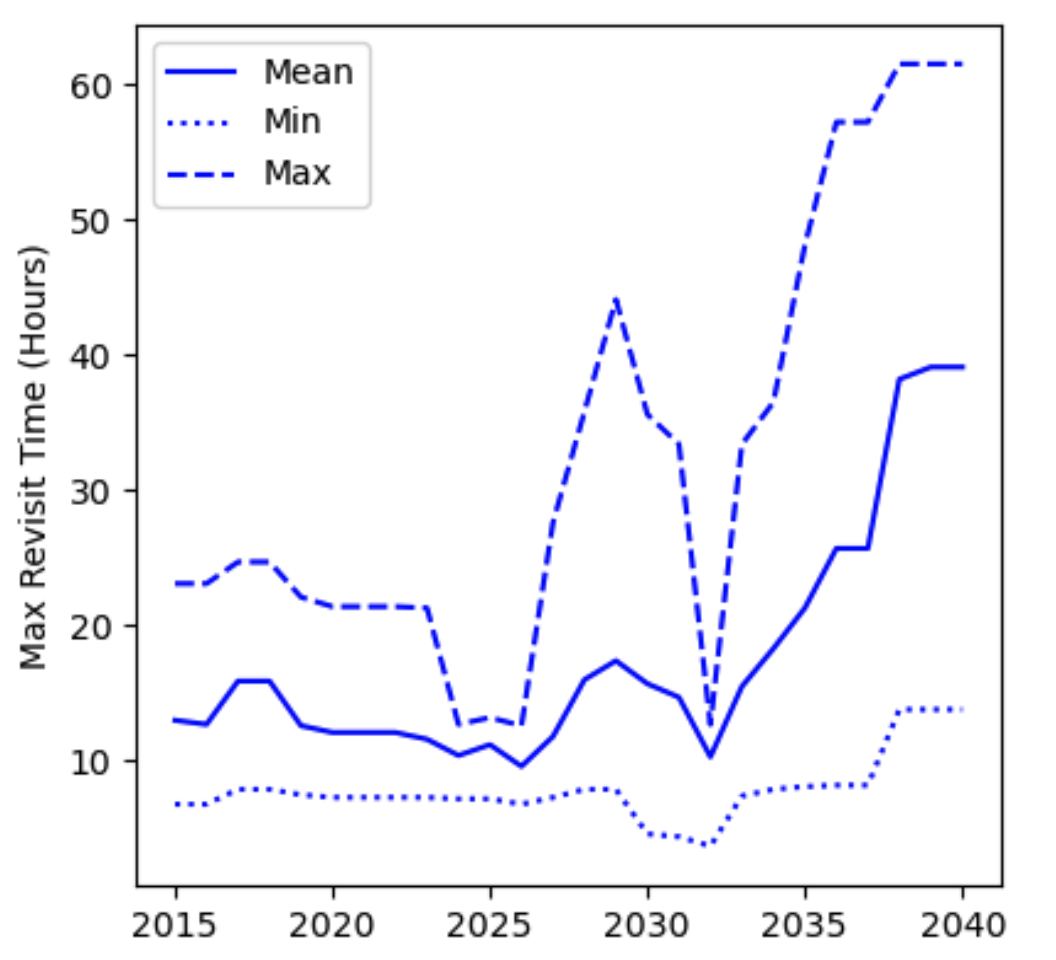
Maximum revisit time (global aggregation) baseline scenario for fire monitoring/detection
Many CEOS Agencies have developed tools and services to operationally detect and monitor active fires. This includes:
- Copernicus’ European Forest Fire Information System (EFFIS), which uses data from MODIS and VIIRS to detect active fires
- NASA’s Fire Information for Resource Management System (FIRMS), using data from MODIS, VIIRS, Landsat and various geostationary satellite sensors
- NOAA’s Hazard Mapping System Fire and Smoke Product, using data from GOES ABI, MODIS, VIIRS and AVHRR
- NRCan’s Canadian Wildland Fire Information System, using MODIS and VIIRS
- Copernicus & GEO’s Global Wildfire Information System (GWIS), which brings together existing information sources at regional and national levels in order to provide a comprehensive view and evaluation of fire regimes and fire effects at global level
However, some of these operational tools are built on data from science missions with uncertain continuity (e.g. MODIS), and hence the continuity of these critical services are also uncertain. Furthermore, there are no current public missions carrying dedicated fire monitoring sensors, and there are often trade offs with other mission objectives when it comes to orbits and sensor characteristics.
To respond to this challenge, WGDisasters established the Wildfire Pilot in 2021 with the aim to provide a comprehensive gap analysis for active-fire Earth observation, considering both the data supply and user requirements. The team have reached the conclusion of this activity, and are working with CEOS to develop recommendations to improve coordination of global active fire monitoring.
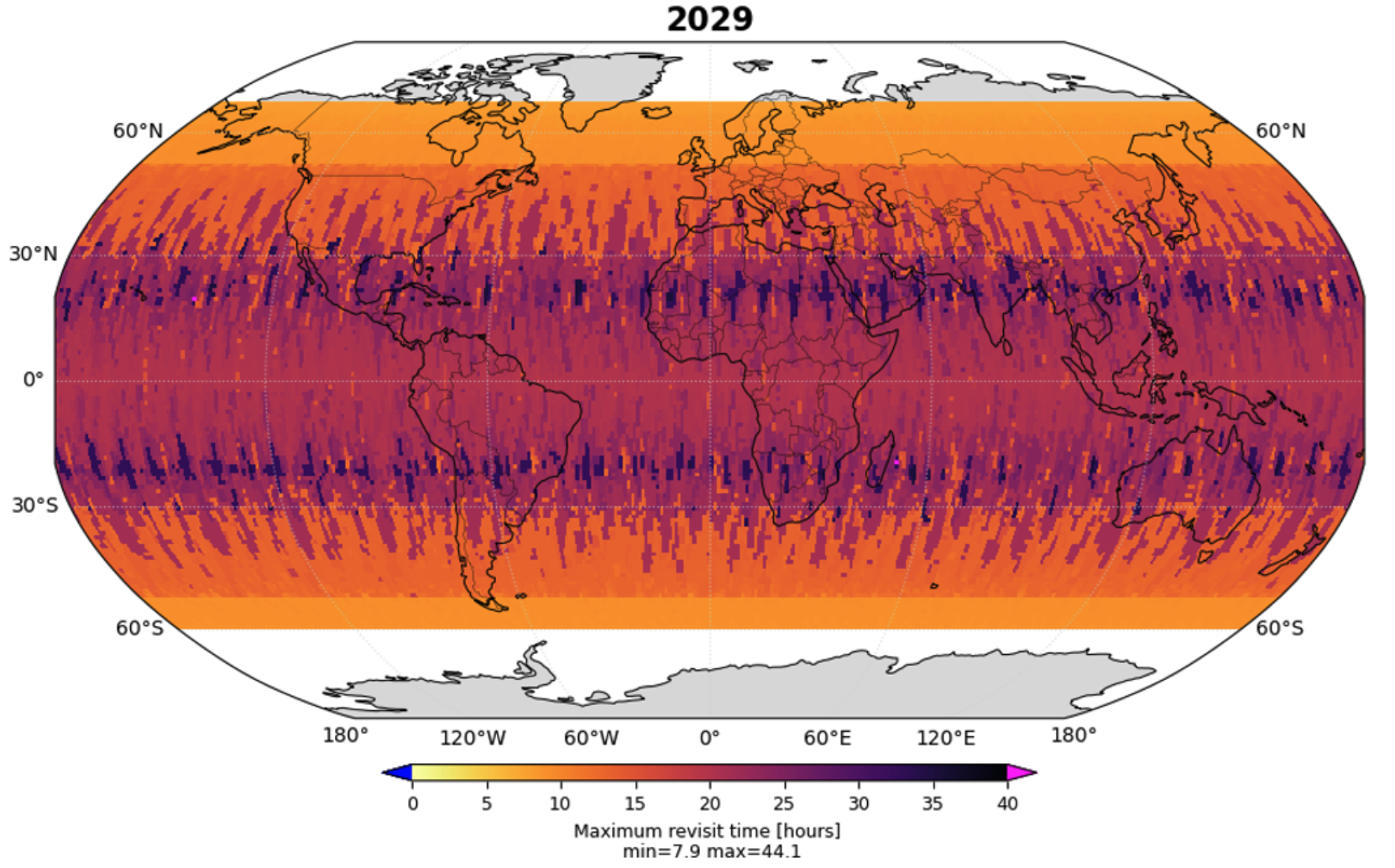
Maximum revisit time in 2029 baseline scenario for fire monitoring
One of the critical characteristics for operational fire monitoring is short revisit times. To effectively detect active fires to support management, data needs to be collected regularly (ideally at least once per day) and downlinked and processed in near-real time. Resolution must also be high enough to pinpoint the fire – less than or equal to 1km. This poses a challenge for many current systems, as those with the fastest revisit times have lower resolution. MODIS, which is carried on both NASA’s Terra and Aqua missions, has a revisit time of 1-2 days and a spatial resolution of 1km for thermal bands, and is hence frequently used for these applications. One way to overcome the challenges around ensuring adequate revisit frequency and spatial resolution is to combine observations from multiple missions in a global fire monitoring virtual constellation.
Following the analysis of the current and future data supply for active fire detection applications, the Wildfire Pilot team found that the global monitoring capability is unstable for at least the next ten years. Even with newer systems coming online, revisit times are not expected to improve, however spatial resolution is expected to improve by the early 2030s. However, many more systems exist that are capable of fire detection and/or monitoring than that have operational products available. This means that revisit times could be meaningfully improved just by leveraging systems that are already on orbit, or scheduled to be in the near future.
The Wildfire Pilot team also surveyed the global fire management community to understand the use of space-based active fire products. The survey found that 87% (216) of the respondents stated that their organisations use space-based active fire products. The 247 respondents came from across the globe, with over 50 countries represented. The survey also indicated that fire managers have a high degree of trust in this data. The full survey report can be viewed here.
With fire managers trusting this data, and relying on it to make critical decisions, it is up to CEOS to find a way forward to ensure these services can continue long into the future, without relying on a small handful of science missions. Better coordination, access and interoperability of data from existing and future missions could help alleviate these issues.
Recognising the need for a holistic approach to space asset coordination and global wildfire monitoring, WGDisasters and the Wildfire Pilot leads are working with the CEOS community to propose a long term, active fire focussed group to bridge the gap between space agencies, private sector initiatives, product developers, and fire managers.
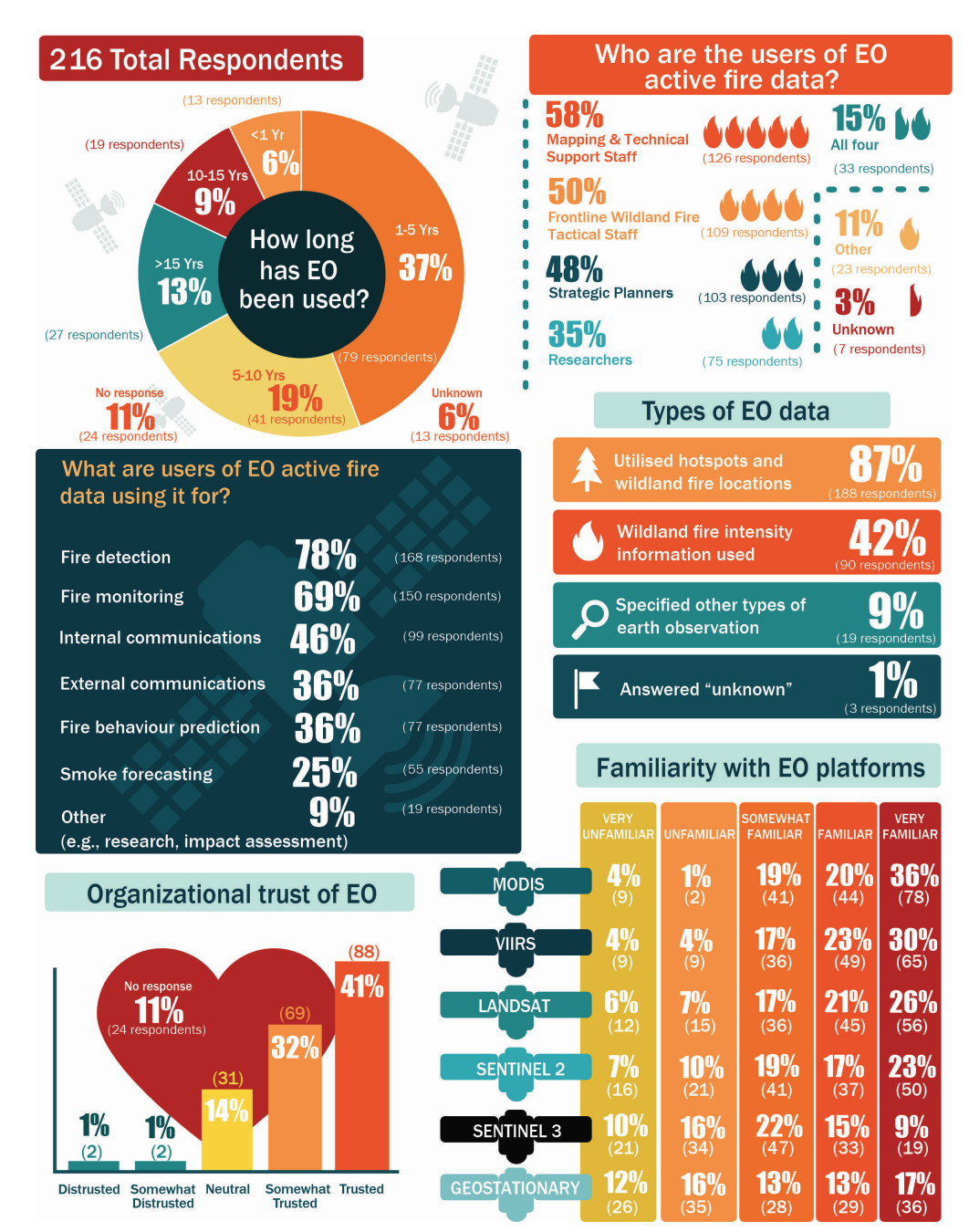
Results of the Global Fire Management Community Survey, and their use of EO products
References:
Hope et al., (2024) https://doi.org/10.1080/17538947.2024.2420821
Johnston et al. (2020) https://doi.org/10.3390/s20185081
McFayden et al. (2024) https://ostrnrcan-dostrncan.canada.ca/handle/1845/275072