Advancing Hyperspectral Data with the Third Atmospheric Correction Inter-Comparison eXercise (ACIX-III)
Spaceborne hyperspectral sensors provide contiguous spectral coverage of the Earth’s surface within the optical and infrared spectrum, enabling the derivation of several biogeophysical products and user applications. Atmospheric correction (AC) is essential for processing satellite data because it removes the effects of the atmosphere (e.g., aerosols, water vapor and dust) that alter the signal before it reaches the sensor. Without robust AC, satellite observations cannot accurately represent the actual reflectance of the Earth’s surface. Yet despite its importance, AC remains one of the most persistent challenges in producing reliable reflectance retrievals from multispectral and hyperspectral missions.

Image over lake Trasimeno (Italy) showing PRISMA L1 (TOA) reflectance (left) and surface reflectance (right) after atmospheric correction using the iCOR AC algorithm
Conducted within the CEOS Working Group on Calibration and Validation (WGCV), the Atmospheric Correction Inter-Comparison eXercise (ACIX) aims to address these challenges with a comprehensive assessment of AC algorithms for multispectral and hyperspectral sensors. The activity began in 2016 and most recently concluded the third exercise, ACIX-III, which assessed the performance of AC algorithms for the EnMAP and PRISMA hyperspectral missions over both land and water surfaces.
ACIX-III provides a rigorous and comprehensive benchmark for validating and improving AC algorithms and informs users about their strengths and weaknesses. The two separate studies, ACIX-III Land and ACIX-III Aqua, intercompared in-situ and spaceborne hyperspectral data over land, inland and coastal waters validation test sites around the globe.
ACIX-III Aqua compared data from PRISMA against coincident observations from the Aerosol Robotic Network – Ocean Colour (AERONET-OC) and a heterogeneous (e.g. WISPStation, WATERHYPERNETS and field campaigns) collaborative validation dataset (CVD). ACIX-III Land compared data from PRISMA and EnMAP against AERONET, RadCalNet, HYPERNETS, Hypersense, and EnVAL in-situ validation sites.
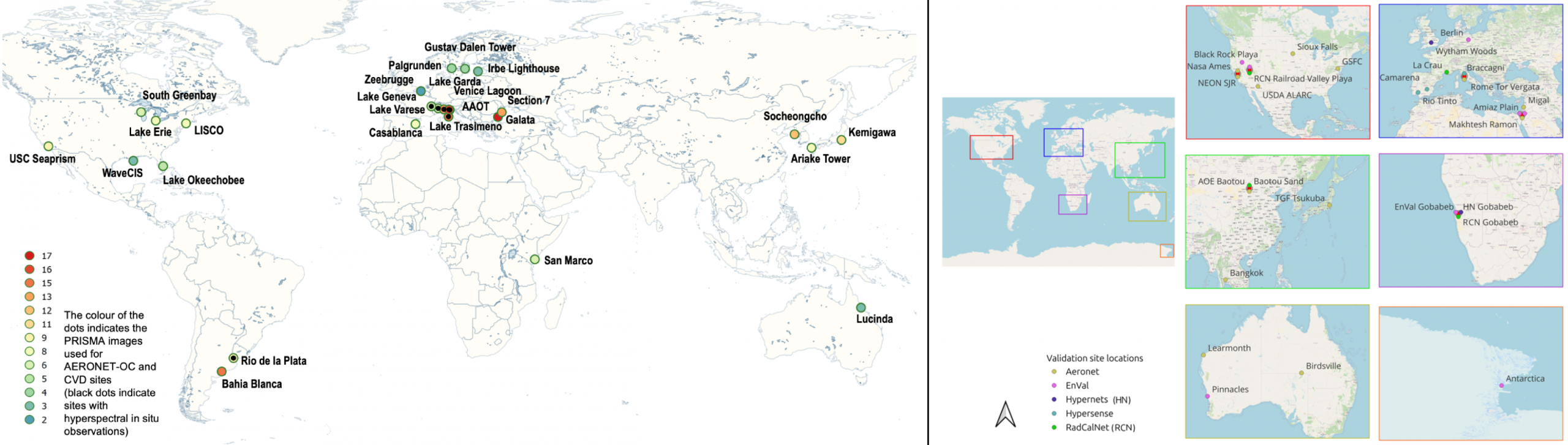
Distribution of ACIX-III Aqua test sites (left) and ACIX-III Land sites (right)
Over 90 different scenes, ACIX-III Land compared the performance of seven algorithms to retrieve aerosol optical depth (AOD), water vapour, and surface reflectance. Half of the algorithms had uncertainties of less than 0.1 for AOD retrieval, and between 0.17 and 0.88 g/cm2 for water vapour, and between 0.02 and 0.04 for surface reflectance. While most algorithms showed a good performance over the test sites, retrievals varied according to the wavelength and sensor, and some had issues retrieving AOD due to a reliance on dark pixels.
Over 239 different PRISMA scenes, ACIX-III Aqua compared the performances of seven AC algorithms across eight different optical water types (OWT). The best agreement was overall observed over greenish waters (OWT 4b), and the lowest discrepancy found at 560 nm. The highest uncertainty was found in dark, humic-rich waters (OWT-7), with the highest discrepancy at 443 nm. No single AC algorithm outperformed others across all OWTs, and the best retrievals varied according to the wavelength and the AC method. The study confirmed the challenges in conducting AC over optically complex waters and reaching thresholds required by GCOS for climate studies.
ACIX responds to the growing interest and relevance of spaceborne imaging spectroscopy for land and water applications, while enabling the advancement of AC methods for future operational missions such as PRISMA-2G, CHIME, and SBG. Looking ahead, the findings of ACIX-III will inform wider efforts to strengthen the robustness of algorithms across diverse seasonal and atmospheric conditions. A potential ACIX-IV could adopt a broader scope and wider diversity of in-situ scenes, enlarging the geographic cover across different ecosystems. Those interested in getting involved in ACIX-IV are invited to contact WGCV.