The Importance of Data Quality in Enabling Interoperability
The CEOS Interoperability Handbook identifies five core factors required to enable effective interoperability of Earth observation (EO) systems and datasets: Vocabulary, Architecture, Quality, Interface, and Policy. The framework recognises that interoperability is not only about exchanging data, but also about maintaining confidence in the quality and meaning of that data when it is shared between systems. Without clear and consistent quality information, data may remain technically accessible but have reduced value if users cannot assess its reliability to compare it across different sources.
The Quality factor of the Interoperability Handbook focuses on providing quality indicators, parameters, and metrics that describe key characteristics of EO data, including accuracy, uncertainty, consistency, and other related performance attributes. These elements allow users to assess the fitness for purpose of EO data for their applications.
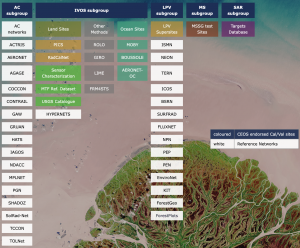
Cal/Val sites coordinated by WGCV
Calibration and validation (Cal/Val) play a central role in the Quality factor by underpinning the accuracy, consistency, and long-term reliability of EO data products. The CEOS Working Group on Calibration and Validation (WGCV) and its subgroups are critical international fora that establish common reference standards, networks, and tools to enable intercomparisons between missions and provide the evidence base for quantifying uncertainties and overall data quality. See the breadth of WGCV’s work here: https://ceos.org/ourwork/workinggroups/wgcv/.
International fora such as CEOS WGCV, WMO GSICS, JACIE, and VH-RODA play an important role in ensuring that Earth observation data are consistently calibrated, validated, and traceable across missions and sensors, thereby strengthening interoperability and user confidence. All data providers are encouraged to actively participate in such fora, to ensure the methods used for calibration and validation allow for interoperability.
Quality assessment frameworks supported by WGCV, such as the ESA-NASA-USGS Assessment Framework and ESA’s Earthnet Data Assessment Project (EDAP), promote transparent, repeatable evaluation of data quality. By ensuring datasets meet rigorous scientific standards for accuracy, consistency, and uncertainty characterisation, the framework supports seamless data integration and builds user confidence for critical operational applications. As more data providers report quality metrics under a common framework, dataset comparison becomes easier, supporting greater interoperability.
The nine Cal/Val recommendations that appear in the Quality chapter of the Interoperability Handbook can be found below. The community is encouraged to review and provide feedback on GitHub.
| ID | Recommendations |
|---|---|
| CALVAL#1 | Data providers should engage and participate in community calibration/validation groups, such as CEOS WGCV (and its subgroups), WMO GSICS, JACIE and VH-RODA. |
| CALVAL#2 | The Measurand and Uncertainty to a reference (ideally SI traceable) of stated values should be included within all products, as they are key to communicating and understanding data quality. |
| CALVAL#3 | All products should have associated quality indicators to allow users to assess the usability of the data for their applications. |
| CALVAL#4 | Post-launch, Level-1 products should be calibrated/validated using reference measurements, such as CEOS Fiducial Reference Measurements (CEOS-FRM). |
| CALVAL#5 | Community-endorsed Cal/Val sites and reference network should be used for satellite cross-comparison, such as CEOS Cal/Val sites, RadCalNet, and/or SARCalNet. |
| CALVAL#6 | The Quality Assurance Framework for Earth Observation QA4EO developed by “The Group on Earth Observations” (GEO) and endorsed by CEOS should be followed to enable interoperability and quality assessment of Earth Observation data. |
| CALVAL#7 | The ESA/NASA/USGS Mission Quality Assessment Framework should be used for reporting metrics related to quality. |
| CALVAL#8 | The Joint Agency Commercial Imagery Evaluation (JACIE) Best Practices document should be used as the guideline for performing standard calibration and validation activities. |
| CALVAL#9 | CEOS CAL/VAL portal should be used as the reference site for accessing community agreed good practices and CAL/VAL protocols for interoperability for Earth observation calibration and validation activities. |