The CEOS/CGMS Working Group on Climate
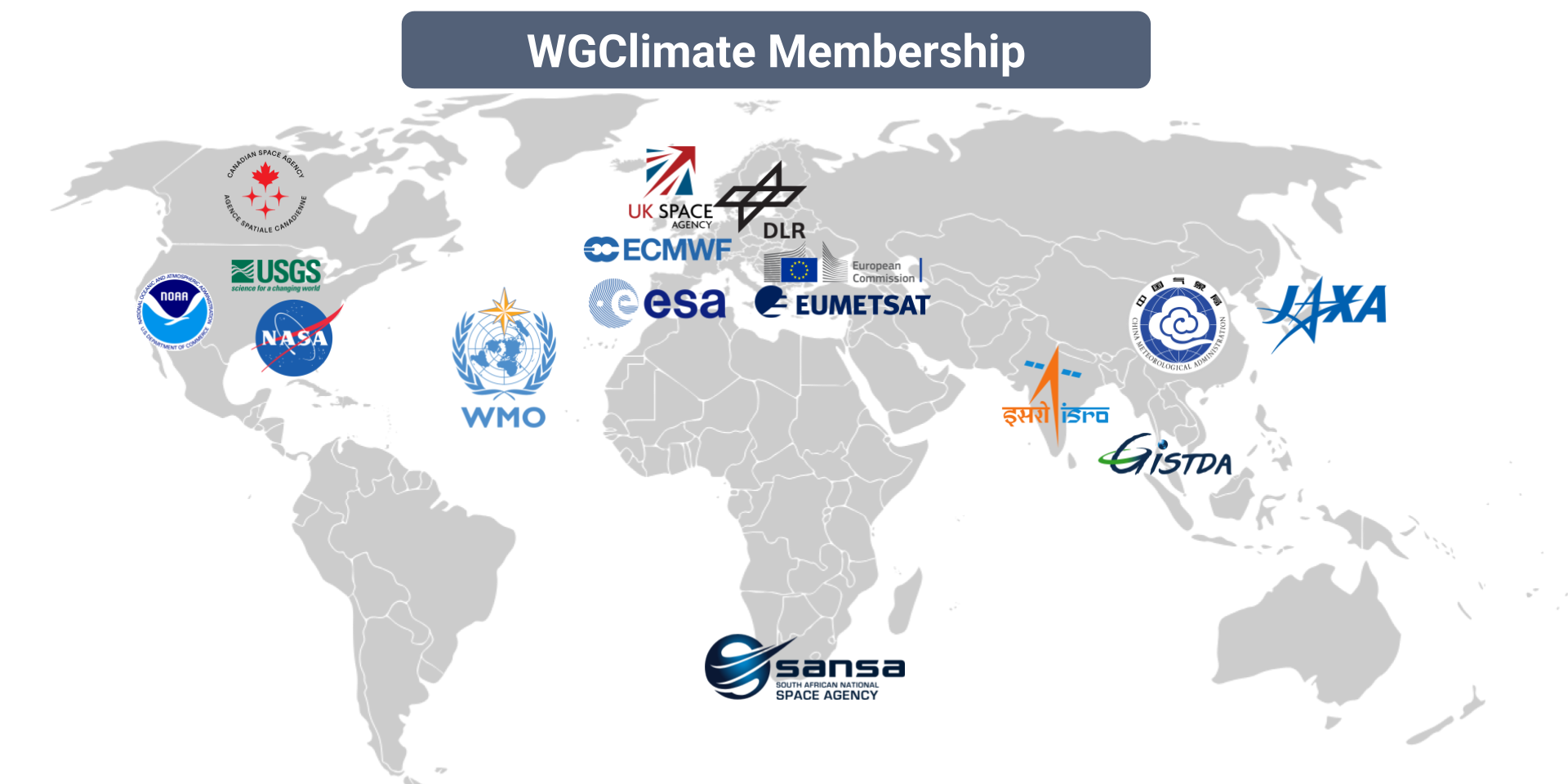 The Working Group on Climate (WGClimate), jointly established by the Committee on Earth Observation Satellites (CEOS) and the Coordination Group for Meteorological Satellites (CGMS) in 2010, is the cornerstone of CEOS and CGMS’ contribution to climate monitoring and the systematic generation of Climate Data Records (CDRs). WGClimate fosters collaboration among the world’s major space agencies to improve the systematic availability, accessibility, and utility of climate-related data from space. Its overarching goal is to support climate monitoring, research, and policy needs through a coordinated implementation of a global architecture for climate monitoring from space. WGClimate is the CEOS and CGMS conduit to stakeholders on matters related to climate.
The WGClimate Terms of Reference provide more detail on its strategy and efforts.
Objectives
WGClimate has the following key objectives:
- Support for GCOS Implementation Plan: Actively contribute to the Global Climate Observing System Status Report and Implementation Plan by aligning space agency efforts with GCOS priorities, particularly regarding Essential Climate Variables (ECVs). This includes responding to GCOS requirements and addressing actions related to space observations.
- Coordination of Climate Data Records (CDRs): Provide a comprehensive and accessible overview of existing CDRs generated by CEOS and CGMS member agencies. Facilitate the generation of new CDRs, including multi-mission datasets, by identifying and addressing gaps in cross-calibration and reprocessing activities.
- Optimized Planning of Satellite Missions: Advise CEOS and CGMS on the optimization of future satellite missions and constellations to expand the coverage and record length of existing and planned CDRs, and address potential gaps relative to GCOS requirements.
- Support for Climate Agreements: Ensure that space-based observations are fully utilized in climate monitoring and reporting, including contributions to international agreements.
Advocacy and Outreach: Promote the use of space-based data for climate monitoring through key platforms such as the UN Framework Convention on Climate Change (UNFCCC), Earth Information Day, and other relevant fora. - Collaboration with Key Stakeholders: Maintain strong partnerships with GCOS, the World Meteorological Organization (WMO), the World Climate Research Programme (WCRP), and other relevant organizations to advance the use of satellite observations in climate science and policy.
WGClimate Activities
CDR Inventory
The Climate Data Record (CDR) Inventory, formerly known as the Essential Climate Variable (ECV) Inventory, is an open resource to explore existing and planned CDRs from space agency sponsored activities worldwide. The inventory is continuously updated by data producers and curators, and supports WGClimate’s Gap Analysis exercises.
Use Cases
WGClimate and WMO collected a series of use cases to demonstrate the value of Earth Observation satellites for societal benefit and decision making. The initiative aims to demonstrate the value of Climate Data Records (CDRs) for decision/policy making and to optimise its usage in applications relevant for climate services and science. Support to capacity building can also be achieved by providing/receiving use cases for/from training activities, namely for developing countries. Additionally, a deeper understanding of the applications needs may lead to quality improvements for the ECV observation requirements defined by GCOS.
GHG Roadmap
The Greenhouse Gas Roadmap, published in 2024, describes the implementation of a constellation architecture for monitoring carbon dioxide and methane from space. The primary objective is to coordinate efforts across CEOS and CGMS agencies to maximise the quality, utility, transparency and continuity of space-based GHG products for science and policy applications.
GHG Portal
The CEOS GHG Mission Portal aims to provide a comprehensive and up-to-date list of all current and planned satellite missions with the ability to measure greenhouse gases, to support coordination and mission planning under the GHG Roadmap. The Portal is based on data from the CEOS MIM Database and aims to support the analysis and planning of GHG measurement continuity by providing visualisation and export capabilities such as measurement timelines and tables of missions and instruments.

GST Portal
The CEOS GST Portal provides an entry point for access to the datasets and guidance being developed by CEOS Agencies and partners in support of the goals of the Global Stocktake process of the Paris Climate Agreement.
Architecture
The Strategy Towards an Architecture for Climate Monitoring from Space, published in 2013, is WGClimate’s overarching guidance document. The Architecture outlines a high-level, conceptual and inclusive strategy to ensure the delivery of space-based observations for climate over the time frames required for analysis of the Earth’s climate system.

Space Agency Statement to the SBSTA
WGClimate annually develops a statement on behalf of CEOS and CGMS Agencies to be delivered by the CEOS Chair delegation to the opening session of the Subsidiary Body for Scientific and Technological Advice (SBSTA) at United Nations Framework Convention on Climate Change (UNFCCC) Conference of the Parties (COP). The statement describes the role of satellite observations in supporting the UNFCCC, highlighting recent developments and advancements.
Space Agency Response to GCOS Implementation Plan
Every five years, the Global Climate Observing System (GCOS) publishes an implementation plan, highlighting a series of actions required to fill gaps in the observing system. WGClimate compiles a response to these actions, summarising the efforts space agencies are making to address the actions outlined by GCOS, highlighting the critical role space-based observations play in observing the climate.
Gap Analysis & Coordinated Action Plan
The Gap Analysis reviews the content of the CDR Inventory (formerly known as the ECV Inventory), identifying gaps, shortfalls and opportunities for improvement for both currently existing and future planned climate datasets. The Coordination Action Plan outlines actions for CEOS and CGMS Agencies to address the gaps identified.